Journal 02
Architectural Essay
The Architecture of the Threshold
When transition acquires depth.
On the spatial work performed between exposure and shelter, one room and another, the known and what remains withheld.
Architecture often begins by drawing a line. Inside is separated from outside; one room ends and another begins; public life is held apart from private occupation. The line is necessary, but it is not yet a threshold. It records a division without describing how that division is experienced.
A threshold becomes architecture when crossing is given consequence. The boundary thickens, light changes, sound recedes, the body slows or turns. What was a line acquires depth and duration. Transition becomes a place in its own right.
- Type
- Architectural Essay
- Field
- Spatial Sequence
- Subject
- Threshold
- Journal
- 02
01
The Line
A boundary can be exact and still remain spatially mute.
A door can close a room without creating an arrival. Glass can divide climate while allowing vision to pass uninterrupted. A change of finish can mark ownership yet leave movement untouched. These devices establish limits, but the architectural threshold begins only when the limit acts upon perception and use.
The question is therefore not where one condition stops and another starts. It is what happens between them. Architecture must decide whether the crossing is immediate or prolonged, exposed or protected, direct or oblique, silent or announced.
02
Depth
The line becomes a sequence.
Depth distributes separation across distance. A reveal, porch, loggia, vestibule, screen or inhabited wall can each extend the moment of passage, but depth is not measured by width alone. It is measured by the number and intensity of conditions held within the crossing.
Exposure may first become filtered, then sheltered, then occupied. Privacy can increase while visual contact remains. Air may continue after rain has been excluded. The strongest thresholds do not replace one state with another at a single point; they allow several states to coexist.
Transition acquires architectural force when it can no longer be understood as a line.
03
Delay
Space is understood through movement, not disclosure alone.
Delay is not obstruction. It is the controlled release of spatial information. A lowered plane can compress the body before a room expands. An offset opening can withhold the centre of a space while admitting its light. A turn can replace frontal entry with gradual orientation.
Partial visibility gives movement purpose. The body advances because the room is not fully available from the first position. Sequence turns perception into an architectural material: what is seen, what remains concealed and the distance between the two are designed together.
04
Light
Passage can be defined before enclosure is crossed.
Light can establish a threshold without coinciding with a wall. A shadow line beneath a deep opening, the reflected brightness of a court or a field of filtered daylight can announce a different spatial condition before the body reaches it.
The gradient matters more than spectacle. Light may narrow attention, reveal thickness along an edge or pull perception through a darker intermediate zone. It gives transition direction and allows the same threshold to change through the day without changing its geometry.
05
Matter
Material transition is spatial when the body can register it.
A threshold may be carried by a stone sill worn underfoot, an acoustic shift beneath a lined ceiling, or the change from a cool mineral surface to timber within reach. Material difference becomes architectural when it alters contact, sound, temperature or pace.
The junction must remain precise. Matter should not decorate the passage after it has been designed; it should determine how the passage holds weight, receives weather and records repeated use. Time then becomes visible through the evidence of repeated crossing.
06
Climate
The edge mediates environmental exchange.
Where climate is treated as a binary problem, the envelope becomes a sealed division between controlled interior and unstable exterior. A threshold offers another model. Shade, rain protection, ventilation and thermal moderation can be distributed through an environmental section rather than concentrated in a single surface.
This depth does not weaken enclosure. It makes enclosure selective. Air, light, view, sound and occupation may each pass to a different degree. The boundary becomes capable of responding without becoming visually or spatially indeterminate.
07
Inhabitation
A transitional space is complete when it can support life.
Occupation changes the threshold from an interval into a room. A ledge or step becomes a place to pause; a deep opening allows conversation to remain connected to both street and interior. These uses need not be formally assigned. They emerge because the architecture provides protection, dimension and proximity.
To inhabit the edge is to remain between conditions without being excluded from either. The threshold can hold observation without exposure, retreat without isolation and encounter without surrendering privacy.
08
The Porous Edge
One manifestation of an inhabited environmental threshold.
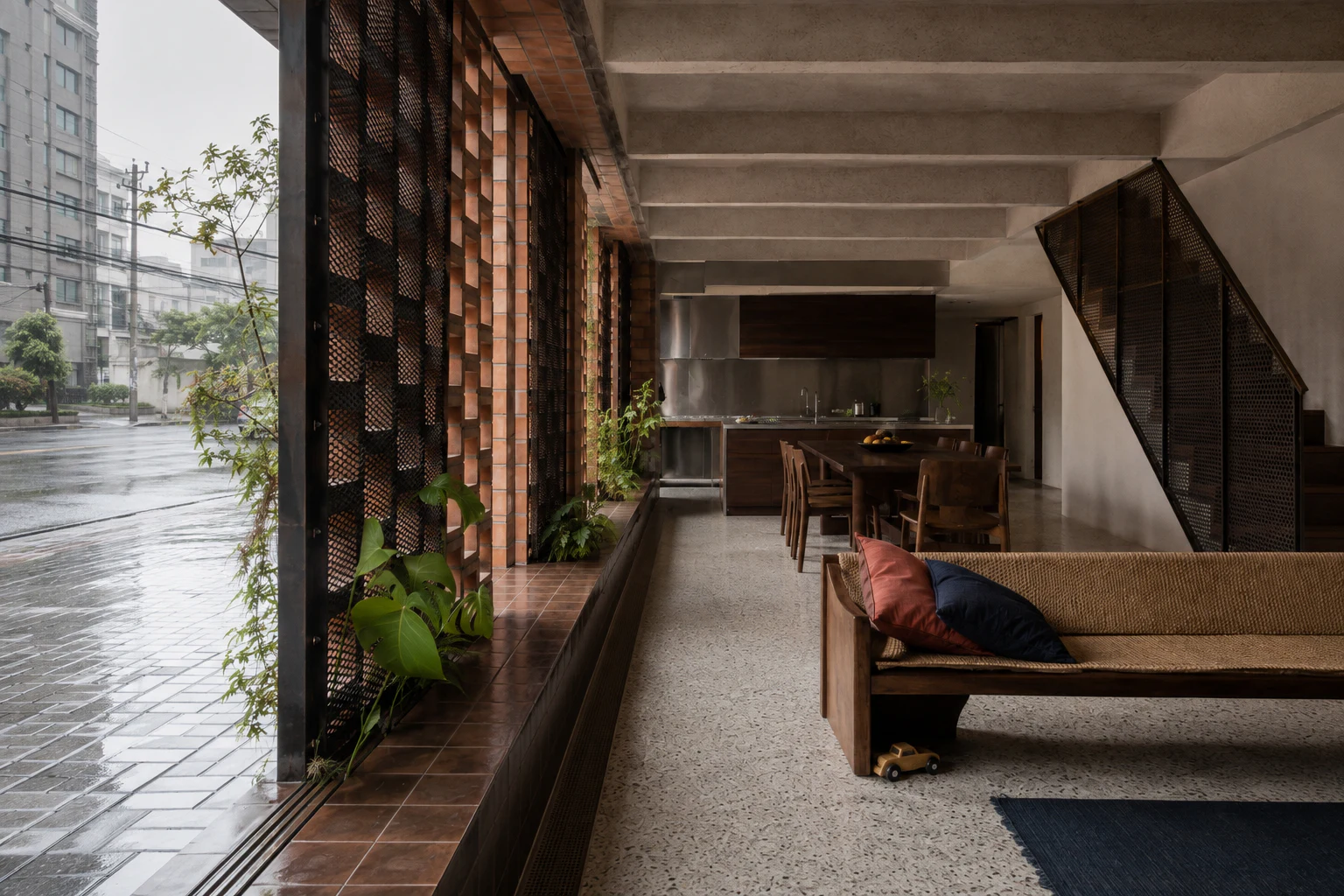
In House of the Porous Edge, the street frontage is thickened into a terracotta-and-bronze climatic field. Rain reaches the outer ledge; air and diffused light pass through perforated masonry and operable mesh; planting, shade and domestic occupation settle within the protected depth behind it.
The façade is therefore not a surface applied to the house. It is the first room. Its threshold is measured in degrees of shelter, allowing the city and home to remain in contact without collapsing their difference.
The threshold is not the remainder between more important spaces. It is the architecture that makes their difference intelligible.
When crossing acquires depth, transition can hold climate, light, matter, movement and occupation at once. The boundary ceases to be a line. It becomes a place where one condition is allowed to change into another without disappearing immediately.