Journal 03
Architectural Essay
One Gesture
Clarity is a question of hierarchy.
On the primary spatial decision that allows complexity, difference and occupation to remain intelligible.
A room may contain many materials, objects, periods and forms of use and still be read as one architectural idea. Another may contain almost nothing and remain unresolved. The difference is not quantity. It is whether the parts belong to an order.
Architecture becomes clear when one decision establishes the terms through which the others are understood. This is the gesture: not an isolated form or a moment of visual emphasis, but a primary spatial relation that gives consequence to everything around it.
- Type
- Architectural Essay
- Field
- Spatial Order
- Subject
- Hierarchy
- Journal
- 03
01
Equal Weight
Confusion begins when every decision asks to be read first.
Complexity is not produced by the number of elements in a room. It appears when those elements make unrelated claims upon the same space. An opening establishes one direction, a ceiling another; furniture gathers around a centre that the plan does not recognise; light emphasises a surface with no spatial authority. Each decision may be coherent in isolation. Together, they compete.
The opposite condition can occur in an empty room. Reduction removes variables, but it does not establish relationships. A space with one chair, one material and one opening may still lack direction, tension or measure. Silence is not the same as order.
02
Order Before Reduction
Architectural clarity comes from hierarchy, not scarcity.
A hierarchy determines what governs and what responds. It allows a room to contain differences without requiring them to become alike. Pattern may remain active, art may keep its own intensity, furniture may come from more than one period and traces of use may accumulate. Their coexistence becomes intelligible because the architecture has already established a primary orientation.
Restraint is useful here as an act of control. It edits emphasis, protects intervals and prevents secondary decisions from obscuring the whole. It need not produce a restrained appearance. A richly inhabited interior may be more rigorously ordered than a sparse one.
One gesture does not reduce the room to one thing. It gives many things a reason to belong together.
03
The Primary Decision
The primary decision establishes the relationships within the room.
A gesture may be carried by mass or absence, by the direction of a horizon, by a sectional change, by the depth of an edge or by the way light is admitted. Its visible form is contingent. Its architectural role is constant: it establishes where the room gathers, how the body moves, what remains withheld and how secondary conditions acquire meaning.
For this reason, the gesture cannot be added at the end as identity. It precedes styling and remains legible after occupation. The plan, section, material field, furniture and light do not need to repeat its shape. They need to understand its authority.
04
Capacity for Complexity
A primary order makes difference possible.
Hierarchy does not ask every layer to agree. It creates enough stability for contrast, density and counterpoint to remain productive. A restored ceiling can retain its historical measure beside precise new joinery. A patterned textile can intensify a quiet material field. An object can interrupt an axis without denying it.
The strength of the whole is tested by what it can absorb. If the room depends on emptiness to remain coherent, its order is fragile. When the primary gesture is exact, occupation can deepen the architecture rather than conceal it.
05
The Secondary
Subordination is a relationship, not a judgement of value.
Secondary decisions are not lesser decisions. They bring scale, tactility, specificity and life to the primary order. Their role may be to reinforce it, occupy it or establish a deliberate resistance. What matters is that the relation is conscious.
A light fitting may reveal the depth of a wall rather than become an object in front of it. Furniture may gather within a field established by structure. Art may hold a pause at the end of movement. Material can make a spatial boundary perceptible through touch before it is recognised in plan. Each layer gains precision by knowing what it serves and where it is allowed to differ.
06
Different Expressions
The organising role remains; its form belongs to the project.
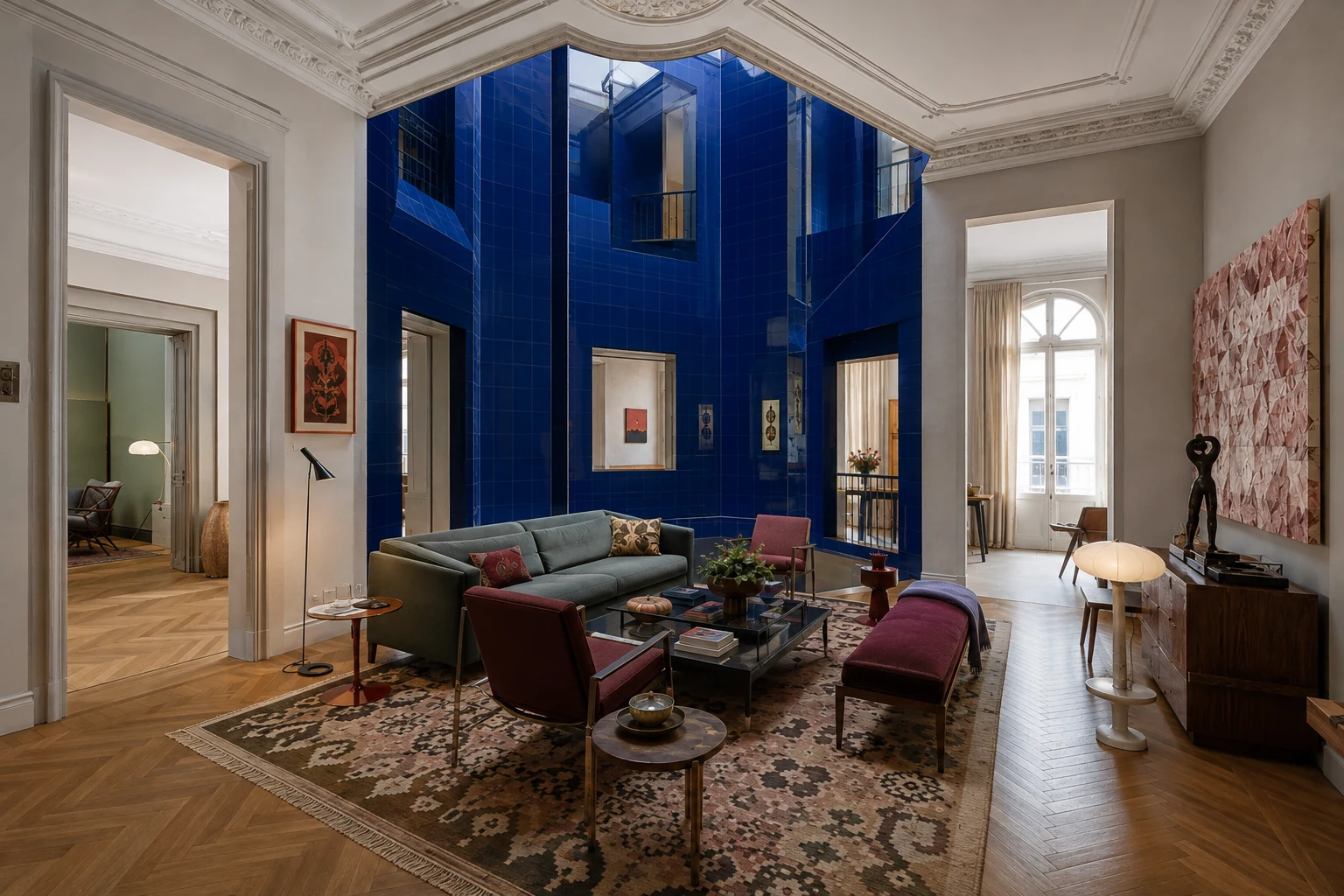
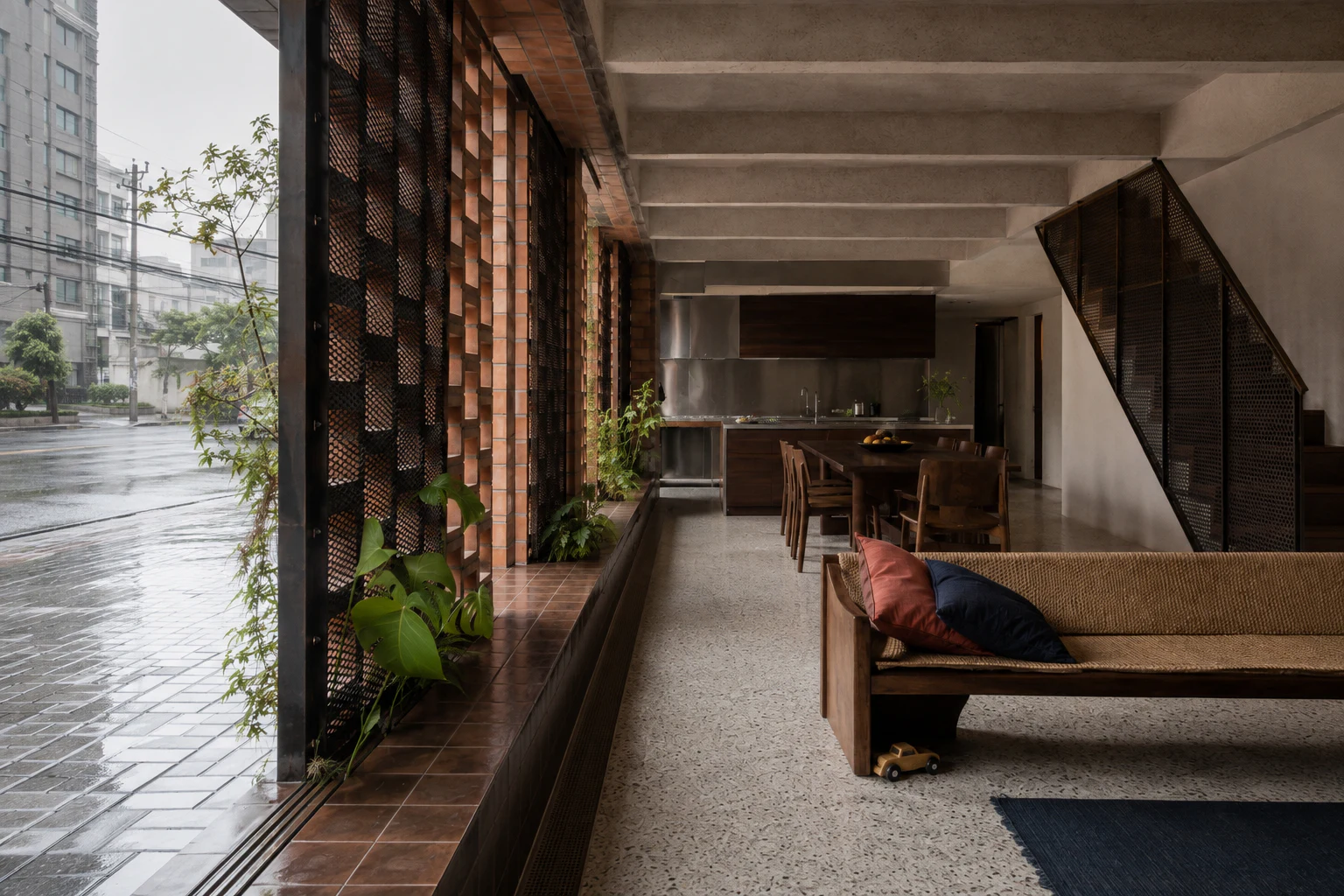
A suspended mass, a long aperture, a chromatic court and a porous edge have little formal resemblance. Their coherence does not depend on a common visual language. In each case, one spatial proposition orders movement, light, material and inhabitation; the expression changes because the conditions change.
The gesture need not repeat from one project to another. What remains is the discipline of deciding what the project is about, then allowing subsequent choices to sharpen that decision.
The strongest room is not necessarily the one with the fewest decisions. It is the one in which every decision understands its place.
Architectural clarity is not the absence of complexity. It is the presence of hierarchy.